Dr. Steven Broadbent knew he wanted to run a quality improvement project. What he didn’t know yet was where to focus it. A Family Physician at Bee Well Medical Clinic in Kamloops, trained at the University of Leicester before moving to British Columbia over two decades ago, the answer came when updated hypertension guidelines led him to look closer at his practice measures in HDC Discover.
The project gained momentum following the release of Hypertension Canada’s updated guidelines, which introduced a lower Blood Pressure (BP) threshold for identifying and managing hypertension. The change prompted the Bee Well team to ask how well their existing workflows and documentation reflected the new standards.
“The change didn’t start with treatment; it began with how we were documenting BP”
Dr. Steven Broadbent,
MD

Finding the Low-Hanging Fruit
Hypertension is one of the most common chronic conditions in primary care, and one of the most consequential when it goes unmanaged, carrying real risks like stroke. It’s exactly the kind of low-hanging fruit that can make a big impact for a large number of patients.
Rather than trying to overhaul chronic disease management across the board, the Bee Well team chose one focus: hypertension. With support from the clinic’s Family Practice Services Committee (FPSC) Practice Support Program (PSP) coach, Chelsey McKinney, they redesigned their workflow around a few concrete changes:
- MOAs took on BP documentation as a defined step in patient intake and coordination.
- Visit templates were standardized.
- Follow-up visits became something the team tracked, not something that happened opportunistically.
Nothing about the plan was complicated and can be summarized in three steps:
- Identify the patients
- Standardize the workflow
- Reflect on the results and trends
Clarity Through HDC Discover
Using HDC Discover, Dr. Broadbent and his team could see, within a single review session, where BP documentation stood against their own practice, Thompson Region and provincial benchmarks. That early signal was the first indicator that something was shifting. “Once we made our workflow more consistent, the data changed very quickly,” explained Dr. Broadbent.
Measurable improvement followed over a three-month pilot period. Within that window, a concentrated 10-day push alone produced 65 hypertension-focused visits across 40 unique patients. The BP documented (HTN) measure in HDC Discover became the clearest early sign of change, while also monitoring the management of BP less than 140/90 measure, showing the downstream effect on patient outcomes.
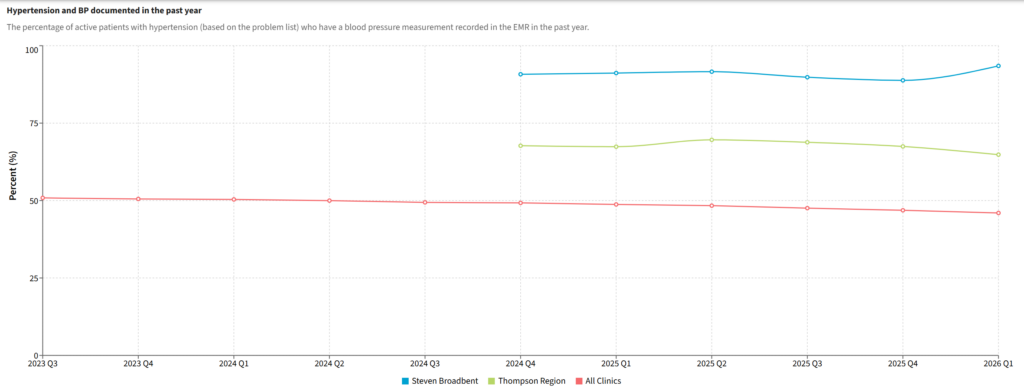
“HDC made it clear where to focus, and helped us see that it was working,” Dr. Broadbent says. What looked, at first glance, like a rise in hypertension prevalence wasn’t a sign that patients were getting sicker. It reflected better case finding, more complete patient registries, and a practice that is seeing its full population of patients with hypertension, not just the ones who came in with it top of mind.
“It wasn’t about doing more work, it was about doing the same work more consistently,” Dr. Broadbent explained.
The clinic team worked together and the load stayed light. MOAs added roughly 7 to 8 minutes per appointment, totaling more than 8 hours of effort across the 3-month pilot.
A modest investment of time from the team translated into a much bigger shift in the quality of care patients received.
Beyond a Single Measure
As confidence in the practice measures grew, so did the scope of the questions Dr. Broadbent asked of them. Working with Frank Fabian at HDC, he looked at his broader panel: over 900 actively attached patients, a substantial senior population, and a meaningful burden of chronic disease spanning hypertension, cardiovascular disease, chronic kidney disease, osteoarthritis, and mental health.
The same practice measures that supported the hypertension work also pointed to strengths worth recognizing, including diabetes management and continuity of care, and to areas where a bit more support could go a long way, including cancer screening and preventive outreach. These became a starting point for a conversation about resourcing, including the potential role of a Primary Care Nurse through the Nurse in Practice Program.
A Catalyst for What Comes Next
The hypertension project was shared through the Thompson Region Division of Family Practice, not as a finished model, but as a starting point other practices could adapt to their own patients and their own teams.
For Dr. Broadbent, the value was never the report itself. It was the ability to see his practice and his patients more clearly, and to know exactly where to focus next.
“I think the real value of data is that it helps you see what you couldn’t see before.”
Contact us at info@hdcbc.ca to explore your own practice BP documentation and control rates in HDC Discover.