The journey began in 2022, when HDC Clinical Services Manager Kent Marley met with the Nurse Practitioners at the Health Care on Yates (HCOY) clinic. The Nurse Practitioners (NPs) had logged in simply to explore their HDC Discover data; maybe uncover a few trends, maybe confirm a few hunches.
““I never expected that using HDC Discover would help my clinic with patient resource development and allocation. This was a very positive and helpful surprise.”
Sarah Jesshope,
Nurse Practitioner, Health Care on Yates Clinic

As they navigated through HDC Discover, they noticed that most of the clinic’s mental health prevalences were significantly higher than any of their comparators. For example, their anxiety and phobias prevalence were showing above 16% while the provincial prevalence was at 4%.
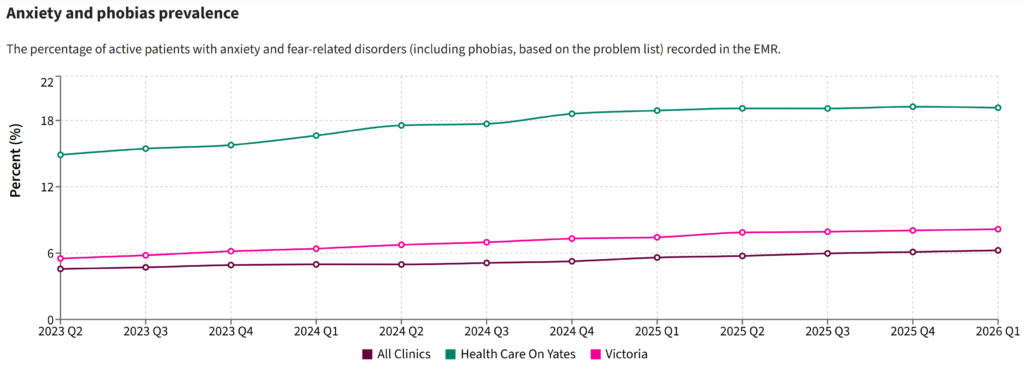
Other mental health measures such as mood disorders, PTSD, GAD, and neurodevelopmental disorders were also much higher than their local division and provincial prevalences. For the first time, these findings confirmed with the NP Clinic what they were experiencing in the clinic.
The questions began: Why are our mental health prevalences so much higher? What’s happening in our patient panel? Is this an accurate reflection of our population? Our documentation?
For the NPs, this wasn’t alarming, it was intriguing. Something that matched their everyday experience but that they never thought would be captured so clearly in their data.
A Clue Hidden in Plain Sight
After that HDC meeting in 2022, the NP team made a deliberate decision: If the clinic wanted to truly understand its patients, it needed to standardize how mental health data was being recorded throughout their clinic.
The team began to code their mental health conditions more consistently, using agreed upon clinic wide ICD9 codes (i.e. Anxiety, Depression, AUD, Child/Youth Mental Health, Drug dependence/abuse, ADHD, Dementia) to help determine whether this elevated trend was isolated or part of a broader pattern.
Growing Prevalence of Mental Health Concerns
In the summer of 2025, Kent returned to HCOY curious to see how the data had evolved. HCOY’s combined mental health prevalence had steadily climbed to nearly 32% from 24% starting back in 2022.
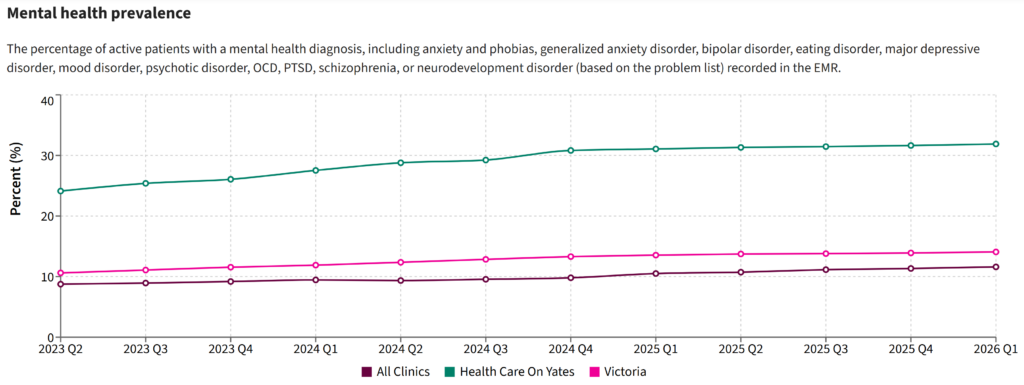
This visualization of change confirmed what the team had been sensing: HCOY was trending consistently higher than other comparison groups relative to patients with mental health conditions.
These HDC Discover insights further fueled the team’s desire to understand why. The patterns pointed to interconnected factors:
- Improved documentation and ICD9 coding revealed higher number of mental health prevalences.
- In 2024 CMHA “In Focus: Mental Health in British Columbia” [1] report highlighted that BC faces high rates of mental-health challenges for adults, worsened by housing insecurity, poverty, and the toxic drug crises.
- A province wide survey shows approximately 38% of BC youth screen positive for depression and nearly 50% of youth 15-17 report ‘Fair to Poor’ in mental health. Potentially a contributing factor as HCOY patient panel has a high proportion of a younger demographic. [2]
It wasn’t a single cause. It was a constellation of influences.
Responding to the Demand for Mental Health Resources
To support their patients, HCOY hired two part-time team members – a clinical counsellor and social worker. The NPs collaborate with these colleagues on shared mental health cases to improve patient outcomes. In addition to the in-house support, HCOY built stronger relationships with community partners to respond to this need. These included community mental health programs, virtual CBT and mindfulness groups, and emergency services.
What began as a simple exploration of a new data tool ultimately reshaped how the clinic understands and supports its patients. The decision to standardize mental health documentation didn’t just refine their charts, it revealed a profound truth about the complexity and needs of the community they serve.
Sarah Jesshope (NP, founding member of HCOY and NNPBC Regional Lead) has a dedication to using Quality Improvement in her daily work and is passionate about learning. She has completed PQI level 2 training and is currently working on a group medical visit QI project and learning series.
“Using Health Data Coalition data to examine common mental health ICD-9 codes gave us a much clearer picture of incidence, visit frequency, and overall clinic use related to mental health. Having that visibility has positioned us to more thoughtfully plan for the future – from prioritizing resources to designing workflows that better support patients with anxiety and depression – rather than making assumptions about where the need is greatest.” – Sarah Jesshope,
Today, the clinic stands confident in its direction, equipped with richer insight, enhanced supports, and a growing spirit of innovation fueled by compassion and informed care, that keeps evolving as the needs of the community continue to unfold.
Sarah is currently working on a perimenopause group visit (which includes supporting patients’ mental health). In the future, she says that HCOY is hoping to offer something for patients suffering from insomnia.
Data as a Compass
The story of HCOY is ultimately one of curiosity transforming into clarity, and clarity transforming into purposeful action. By embracing data not as a judgment but as a compass, the Nurse Practitioners and clinic team uncovered the deeper realities of their community’s mental health needs, insights that had long been felt but never clearly seen. Providing them with the foundation to make the necessary changes to support their patients.
Want to learn more about how HDC can support you? Reach out to HDC’s community team at info@hdcbc.ca to connect with our team.
See also Bright Spot story: (Nurse Practitioner Primary Care Clinics’ Trends Validate Patient Focus – Health Data Coalition)
Refrences
- Simon Fraser University – consolidated report from the 2023 Youth Development Instrument (YDI) survey of 14,596 young people in 28 school districts and 28 independent schools across BC YDI-2024-Provincial-Report_Nov-13-2024.pdf