
When stories began emerging of late-stage cancer appearing in patients admitted to emergency rooms, a group from seven clinics in Prince George knew they needed to act. The group, led by Dr. Jess Zimbler, consisted of family physicians together with their medical office assistants (MOAs), and Family Practice Services Committee’s (FPSC) Practice Support Program (PSP) coaches, were committed to examining their workflows to ensure patients received preventative screening before cases progressed too far.
The results show the power of connection, peer learning, and common goals, with meaningful community support, can positively impact patient outcomes and sustained practice change.
Over six months, the group focused on three screening areas: breast, colon, and cervical cancer. Two face-to-face sessions book-ended a testing period where clinics examined workflows, tried new strategies, and reached hundreds of patients.
Momentum Building Through Connection and Common Goals
The first meeting sessions were set for late spring of 2025; an hour and a half over a provided meal, focusing on knowledge sharing, revisiting screening guidelines, and discussing workflows and strategies currently in use across participating clinics. Representatives from BC Cancer in Prince George and the Northern Health Authority attended to review processes and answer questions. Staff from Bright Health MOIS EMR, also participated, reviewing the EMR structured data entry process.
“It was amazing being in the same room and seeing the energy behind wanting to provide the highest quality of care to patients,” Angie Sackney, Practice Improvement Coach, noted. “This was our first coaching group session since 2022, and we were unsure what to expect. We were delighted to see the enthusiastic conversation among peers, with many lingering for over an hour after the first in-person session!” With so many individuals working in relative silos, it seemed the event was reinvigorating a need for connection and a common goal for Prince George primary care clinics.
Addressing Barriers and Finding Solutions
Over the duration of the project, the Practice Improvement Coaching team used the HDC Discover application to track the group’s changes in screening rates over time. Within HDC Discover, a member group was formed where individuals were invited to join the Prince George Cancer Screening group. This automated the data collection process typically associated with Electronic Medical Records (EMR) based improvement projects, providing an easy way to track both individual and group progress.
A collective decision was made to focus on finding patients who had never had a screening test for breast, cervical, or colon cancer. Participants were interested in cervical screening because the recent introduction of HPV self-administered screening tests was well received as a less invasive approach. Representatives from Bright Health MOIS EMR, along with Northern Health and BC Cancer personnel were on hand to support participants to better utilize features of their EMR and to answer questions related to provincial services available to Prince George patients.
Implementation Through Continuous Quality Improvement
With implementation support from multiple groups, participants returned to their clinics with more confidence, workflows, and tools to embed into their practice. Hundreds of patients were contacted and offered screening with many accepting the offer. In one clinic, the exercise uncovered a case of colon cancer that may have gone unchecked if not for this group project. In another, two patients were diagnosed with breast cancer through their first mammogram, caught as a direct result of the project. A powerful validation of the time providers invested in improving their care.
This group conducted 16 quality improvement projects focused on optimizing screening workflows. Between the two in-person sessions, participating clinics completed:
- 179 mammograms
- 87 cervical cancer screenings
- 98 colon cancer screenings
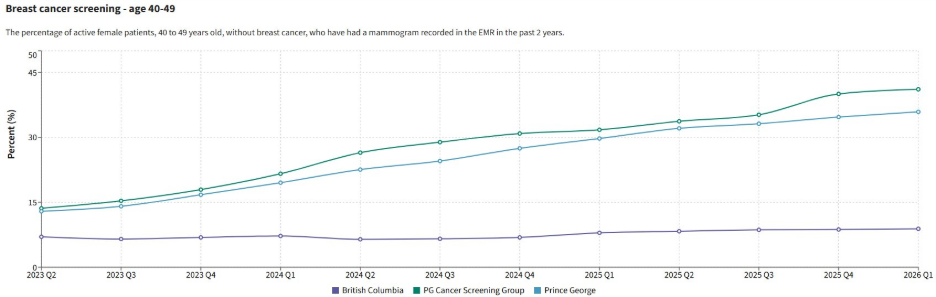
The impact continues to be visible in HDC Discover data months after the last session completed, speaking to the sustainability of the optimization efforts.
During the second group meeting, six months later in the autumn, the team identified barriers to accessing screening procedures and debated strategies to overcome these challenges.
Within HDC Discover, the Prince George Cancer Screening group aggregate data was viewable to all members. They used it to track progress, easily seeing positive changes well beyond the end of formal small group sessions. This illustrated a sustained change realized by optimizing workflows to continuously screen individuals as they enter the “screening window.” HDC Discover provides this consistent view to support continuous quality improvement for clinical teams. Since the end of the project, clinics participating in the small group experience have maintained screening rates above the average for the region.
Moving Forward
The momentum started with this project is continuing, Angie Sackney and Angela Shymanski, both Practice Improvement Coaches, relate, “We’re continuing to support physicians and clinic teams as they strengthen their clinic foundations and also work on meaningful quality improvement projects. By using HDC data, we are helping physicians and their teams celebrate their successes, identify opportunities, and focus on goals such as improving chronic disease management and proactive/ preventive care, including cancer screening. Across the region, we’re seeing teams focusing on common priorities like improving patient access, strengthening continuity of care, and getting the most out of their EMRs to support both patients and clinic workflows.” The team is also working with clinics to build on the momentum from their cancer screening projects. “Whether it’s reviewing HDC data together, refining recall processes, or improving screening workflows, the focus is on creating sustainable changes that make it easier to provide proactive, high-quality care for patients.” Angie and Angela conclude.
If this story resonates with your team, reach out to your local FPSC’s Practice Support Program Coach or to the HDC Clinical Services team to learn how HDC Discover can support your connection, peer learning and common goals for your community.