
Family practices have always had instincts about their patient populations. A family physician might sense that their practice sees more mental health concerns than diabetes. A nurse practitioner might notice they’re serving more older adults than young families. But in the demanding pace of daily practice, these hunches rarely translate into concrete action or strategic resource allocation.
For Victoria’s Primary Care Network, this gap between intuition and evidence was holding back their ability to deliver truly responsive, team-based care.
The answer emerged through a partnership between the Victoria PCN team and HDC, leveraging HDC Discover to create what has been described as “a common language for understanding our community’s health needs.”
The Challenge:
The shift toward team-based care represents one of the most significant transformations in primary care delivery. Yet this evolution exposed a fundamental tension. While the model calls for integrated, collaborative approaches, most family physicians and nurse practitioners continued managing their patient panels independently, often unaware of patterns emerging across their community or opportunities to learn from neighbouring practices.
“Before participating in HDC, practices couldn’t easily see their own data in context, let alone compare notes with other clinics to identify where collective efforts should be focused.” explains Cara Miller, PCN Project Lead for Victoria.
Without reliable, comparable data across practices, critical decisions about where to deploy allied health resources or target screening programs relied more on guesswork than evidence. Perhaps more significantly, the lack of shared data meant missed opportunities for practices to learn from one another and for networks to track whether redesign efforts were improving patient care.
Building Trust Through Transparency
The founders of the Victoria PCN recognized that collective primary care data could be the key to unlocking collaborative improvement across Victoria’s primary care community. Working alongside Cara Miller and Kent Marley, HDC’s Clinical Manager, the team began exploring how HDC Discover’s group function could create anonymized cohorts of practices.
The technical solution was straightforward. HDC Discover could aggregate EMR data from participating clinics into cohorts, allowing the PCN team to see patterns across groups of practices while maintaining each clinic’s anonymity. The interpersonal challenge proved more complex.
The PCN team approached this carefully. Leveraging trusted relationships already built with participating clinics and clearly outlining the reasons behind the invitation to share aggregate data proved essential to getting agreement in place. Each clinic received an invitation to participate in a grouped cohort, with transparency about how their privacy would be protected through aggregate data.
The response exceeded expectations. In addition to agreeing to participate in a grouped cohort, the majority of clinics across the six groups cohorts also agreed to share their clinic aggregate HDC data with the PCN leadership team.
From Data to Discovery
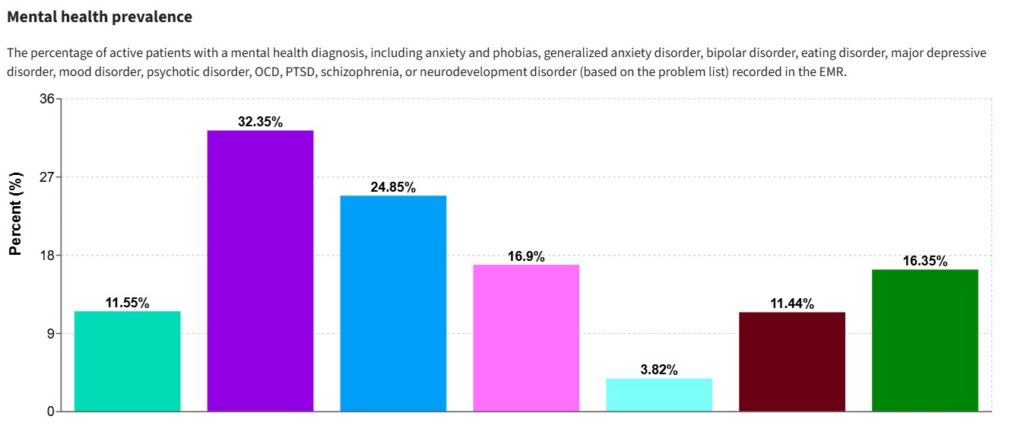
With cohort-level data flowing through HDC Discover, patterns that had previously been invisible suddenly came into focus. Mental health prevalence varied dramatically across cohorts (see Figure 1), while chronic disease patterns told a different story. Some cohorts revealed significant gaps in chronic kidney disease screening despite documented diabetes prevalence.
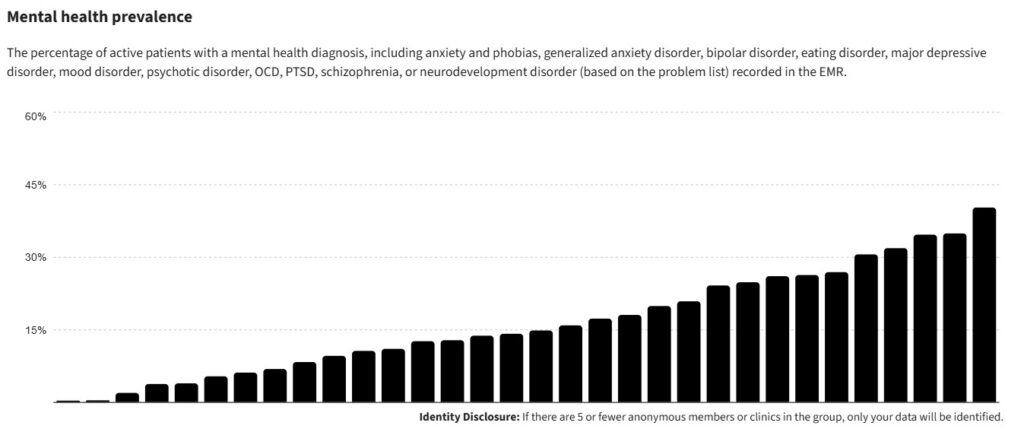
These insights immediately informed resource allocation. A cohort with elevated mental health needs might benefit most from a PCN Mental Health & Substance Use Consultant and a PCN Social Worker, while a practice serving many patients with complex chronic diseases might prioritize access to a PCN Clinical Pharmacist.
“I appreciate the increase in HDC Discover measures that may inform our PCN work,” says Miller. “It might help us select clinics that would most benefit from a new allied health resource or guide PCN nurses in seeking out measures that reveal where patient education could raise screening rates.”
Most powerfully, the shared data transformed quality improvement into what Miller describes as “a team sport.” When everyone could see a common baseline, each team member could contribute insights from their unique perspective.
Real-time Insight
HDC Discover’s near real-time data, queried quarterly, eliminated the data lag that plagued traditional quality improvement initiatives. PCN teams could now evaluate redesign efforts during implementation, providing timely feedback on whether changes were working.
A screening initiative showing early promise could be expanded. An intervention falling short could be adjusted before significant resources were invested.
“The data helps us guide our trajectory,” Miller explains. “We can see in close to real time whether we should continue our current efforts or stop to reflect and refocus. It eliminates the need for manual data collection and reduced reliance on valuable MOA time.”
Beyond Numbers: Fostering Dialogue and Learning
When practices could see anonymized comparisons across cohorts, it sparked conversations that isolation had prevented. Why might one cohort show higher screening rates than another serving similar populations? What workflows are others implementing?
Critically, this dialogue kept clinical context front and centre. The aggregated data provided a starting point for conversation, not a rigid prescription for practice. The PCN also incorporates HDC Discover measures to onboard a registered nurse (RN) to a new clinic. Reviewing the patient demographics and practice measures is quite helpful since many family physicians and nurse practitioners aren’t sure where the RN should start. This way, the RN can know what kind of initial case finding can be expected.
Keeping family physicians and nurse practitioners in the conversation when data is being discussed is critical to maintaining this context. HDC Discover prioritizes confidentiality through aggregate visualizations and relies on individual consent when any practice data is grouped or shared. This responsible approach helps family physicians and nurse practitioners feel comfortable sharing data for the betterment of community health.
System Redesign in Action
For Victoria’s PCN teams, HDC Discover data has moved from informing discussions to actively shaping system redesign. When deploying new allied health positions, PCN leadership can now identify which cohorts would benefit most based on documented patient needs rather than assumptions. Baseline data helps teams plan new initiatives with clear understanding of current state, while ongoing data allows teams to monitor impact and adjust resource allocation to support the right teams at the right time.
Practice groups launching improvement initiatives can establish clear baselines, track progress, and compare outcomes across similar practices. This shared measurement accelerates learning and refinement in ways that isolated practices could never achieve.
“The data helps us guide our trajectory… We can see in close to real time whether we should continue our current efforts or stop to reflect and refocus. It eliminates the need for manual data collection and reduced reliance on valuable MOA time.”
Cara Miller,
PCN Project Lead, Victoria

Looking Forward: An invitation to Collaborative Transformation
The Victoria PCN experience offers a model for communities seeking to move beyond isolated practice toward truly integrated, data-informed care delivery. PCN teams across British Columbia have access to HDC Discover through their Division partner. The Victoria PCN experience provides a roadmap for implementation.
The path forward requires PCN teams to invest time in building trusted relationships with practices, clearly articulating the value proposition of data sharing, and creating structures for ongoing dialogue about what the data reveals. It demands commitment to maintaining family physician and nurse practitioner confidentiality while fostering transparency about population-level patterns. Most fundamentally, it requires seeing data not as an endpoint but as a catalyst for continuous conversation, learning, and improvement.
As Victoria’s six existing cohorts continue to evolve and new cohorts are being prepared, the PCN team remains focused on expanding and deepening the insights HDC Discover provides. Each new measure explored opens fresh possibilities for supporting practices and improving patient care. Each conversation sparked by shared data strengthens the collaborative foundation that makes meaningful system change possible.
For primary care communities ready to transform hunches into action and integration, the tools exist and the model works. What other support do you feel is needed to get this started in your PCN?
Ready to explore how HDC Discover can support your PCN work? Reach out to HDC’s community team at info@hdcbc.ca to connect with experts who can help turn your HDC Discover account into a powerful tool in your PCN toolbox.