Dr. Daisy Dulay is a cardiologist with a strong commitment to healthcare well-being and quality improvement. She founded the Physician Wellness Group through the South Island Medical Association to support the mental and physical health of her colleagues. She joined the HDC Board of Directors in fall of 2024. Below she shares her thoughts on the importance of caring for one’s self to allow one to care for others on Crazy Socks for Docs day.
Today, as I do n my brightest socks for Crazy Socks for Docs, I’m reminded how small, visible acts can spark big conversations about physician well-being. Our work at the Health Data Coalition (HDC)—“Sharing Stories, Using Data, and Centering Sevā in Healthcare Improvement”—reflects that same spirit of care.
Sevā (ਸੇਵਾ), derived from the Sanskrit word “sev,” means “to serve.” In South Asian culture, it represents selfless service as a path to spiritual growth. As a teenager, I knew I wanted to become a physician to support others’ wellness—but never at my own expense.
During the pandemic, I faced a harsh reality. Burnout left me questioning whether I was truly serving myself. In a shame-based culture that prioritized survival over learning, fear held me back—fear of asking for help, making mistakes, and compromising patient safety. Breaking free from that fear required courage—courage rooted in my instinct to serve. Asking for help, even when it was hard, was the right thing for my patients and myself.
Healthcare worker wellness is more urgent than ever. Collecting stories and gathering information is a way to reflect on the difficult times that healthcare workers have experienced. Storytelling helps us reflect on challenges, fostering empathy for each other, our patients, and ourselves. This qualitative and quantitative approach increases empathy and compassion towards each other, patients, and ourselves. It also inspires action.
Quality runs in my family. My father worked in the manufacturing world as a quality control inspector. My aunt was in quality for the pharmaceutical industry. Quality improvement (QI) was discussed in our home, and as a result, it has been woven into my work. One of the fundamental questions around QI is how do you know, when you make a change, is it effective? The only way to get proof is by measuring again. That is a data-driven approach to quality improvement. If you don’t collect information and examine it critically, you can’t make a change.
As a South Asian, second-generation settler, physician, mother, and healthcare advocate, I’ve carried many roles shaped by service. For years, my career in cardiology brought a sense of purpose and pride. I started in Ottawa as a locum, then moved to British Columbia, where I took on more responsibility and deepened my practice.
But as the pandemic unfolded, the weight of a strained system, unresolved work conflicts, and moments missed with my family began to accumulate. Though I was physically present, I no longer felt like myself. I kept pushing, telling myself to lean in harder—until my body pushed back.
One day on call, dread overwhelmed me. My chest tightened. My legs gave way. I couldn’t breathe. In that moment, I had to choose: seek help or keep going and risk everything. I chose help. It was the hardest—and most necessary—decision I’ve made.
That moment didn’t end my career. It transformed it.
Burnout forced me to pause, reflect, and realign. I embraced boundaries, reconnected with my values, and let go of the version of myself built only for survival. I learned that healing doesn’t mean going back to who you were—it means becoming who you were meant to be.
Today, I continue to serve, but from a place of wholeness. The principle of Sevā—selfless service—still grounds me, but no longer at the expense of my well-being. I believe we must create healthcare environments that are safe not just for patients, but for those who care for them.
Burnout is real. But it doesn’t have to be the end. Sometimes, it’s the start of something better.
For physicians to thrive and be able to serve and support others, we need healthcare environments that allow us to care for ourselves and be empowered to speak up when we are nearing our limits. A culture of honesty and support prioritizes patient safety and protects our care providers in a psychological safe way. When healthcare workers feel safe and supported, patient care wins. The mental, physical and emotional wellness of healthcare workers should matter deeply to patients, organizations, and governments.
Through my previous work as a Doctors of BC physician representative in psychological and physical safety working groups and collaboration with the local health authority and the BC Ministry of Health, and now with the Health Data Coalition (HDC), I have broadened my expertise beyond cardiology, blending data-driven approaches with practical, compassionate care.
It’s easy to recognize what’s wrong in healthcare—but burnout can leave you feeling isolated and powerless. What helped me rebuild was engaging in Quality Improvement (QI). QI reconnected me to a sense of purpose, agency, and autonomy. It’s not just about fixing broken systems—it’s about working in teams, using data to understand what’s really happening, and collaborating toward solutions that matter. QI gave me the structure to act, the support to try, and the community to believe change was possible again.
Data can be very validating. Looking at trends that reflect your efforts enhances your agency and well-being. When this happens, you feel better and more connected again. It takes a lot of strength and courage to reflect on your own practice, because the initial results may not meet your expectations. Don’t dismiss it. Get curious to better understand why your practice trends look the way they do.
Through QI, I have discovered a well-rounded purpose that supports my wellness and health while advancing people-centered care. It has given me the agency and courage to approach care differently in a way that aligns with my values. We can rely on data to inform quality improvement to ease burdens on nurses, physicians and practitioners and to enhance patient care. Using insights from data results in a professionally satisfying practice and leads to improved patient outcomes. I’m passionate about enabling collaborative change as a HDC board member. By prioritizing healthcare workers’ wellness, we safeguard patient care. I’m inspired by the initiatives the HDC is doing to enable collaborative quality improvement in primary care. I look forward to sharing more of the work I’m doing with the HDC, Doctors of BC and others.
Sevā remains my guiding principle. I’ve learned that serving others starts with serving myself and my family first. This understanding has shaped my path and the stories I share to foster growth and connection. 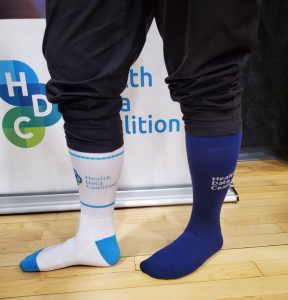
Today, as I wear my crazy socks, I invite you to reflect on your own values, share your stories, and join us at HDC. Together, by using data for actionable, human-centered improvement, we can create a healthcare system where everyone—patients and providers alike—can thrive.
Do you have a similar story that you’d like to share? Connect with me on LinkedIn and let me know if sevā resonates with you.