Quality Forum is a great venue for meeting all sorts of people from different areas within our health system. It was at such a chance meeting at Quality Forum 2023 that Dr. Kevin Liang discovered the Heath Data Coalition (HDC). Dr. Liang has a passion to support mindful practice of medicine and its impact on the environment, for which he simply asked how HDC’s Discover application might support his “Low Carbon Care is High Quality Care” mission. The result is HDC’s new low-carbon inhaler measure set, which supports the spread of this initiative across the province and motivates change.
Dr. Liang’s perspective is clear: clinicians can reduce the number of metered dose inhaler prescriptions to provide high quality care AND sustain a healthier environment at the same time. Canada sits well behind other countries across the globe who are already prescribing climate friendly inhalers for patients living with COPD or Asthma. As outlined in a BCMJ article by Dr. Liang, he encourages clinicians to switch inhaler prescriptions away from the metered dose inhalers commonly in use today. A single metered dose inhaler emits as much carbon as a 170 km car ride! Even “empty” inhalers still contain a significant amount of carbon to discharge, which continues to impact our climate even when the patient is “done” with the inhaler.

This project fits well with the HDC’s purpose to enable data-informed patient care through practice improvement to support the quintuple aim. This initiative supports all HDC Discover users to assess, plan and apply their knowledge to accomplish three aims simultaneously: enhance the patient care experience, improve the clinician’s experience and reduce the environmental impact to our planet. These aims are resonating widely with our users.
The measure co-design process requires rigor
Our internal teams quickly mobilized to work with Dr. Liang to explore what a measure set might contain and how best to approach this topic area in a way that was both simple and comprehensive. Dr. Liang’s approach is to consider three aspects of care for patients with COPD and Asthma, illustrating for providers areas where they could make positive change:
- the RIGHT diagnosis,
- the RIGHT inhaler, and
- the RIGHT use of metered dose inhalers.
We worked with Dr. Liang to develop measures that could appropriately tease out information present in the Electronic Medical Records (EMRs) to show providers where they could make some changes.
Many factors play into the feasibility of developing a particular measurement. As an example, we decided to move away from use of the World Health Organization’s Anatomical Therapeutic Classes (ATC) as a way of grouping prescription drugs for measurement purposes. To date we have been using ATC codes as it is at a higher level of classification than using individual Drug Identification Numbers (DINs), which are assigned to every level of active ingredient, formulation and dose combination marketed in Canada today. We tested the feasibility of using DINs in this measure set as metered dose inhalers and dry power inhalers fall into the same classes based on active drug ingredients. Dr. Liang helped us to determine these medication lists and confirmed our assignment of each available inhaler currently available in BC into high carbon emitters (metered dose) vs. low carbon emitters (dry powder and soft mist). This clinical knowledge greatly reduced the amount of research our small team had to conduct and leveraged the work already done by Dr. Liang and his colleagues with the Fraser Health Planetary Health committee and support from Cascades Canada and Health Quality BC.
The measure co-design process is collaborative and iterative in nature
Most of our team’s effort tries to balance clinical guidance, alongside what is currently accessible within the primary care EMRs to provide measures that are relevant, useful and easily understood by primary care providers. This work was done by our internal clinical informatics team, relied on feedback cycles from our clinical services team and input from clinicians on our Clinical Data Stewardship Committee, who ultimately would approve the measure set for inclusion in our HDC Discover application. Once the measure definitions were validated, the project team could provide direction to our technical team.
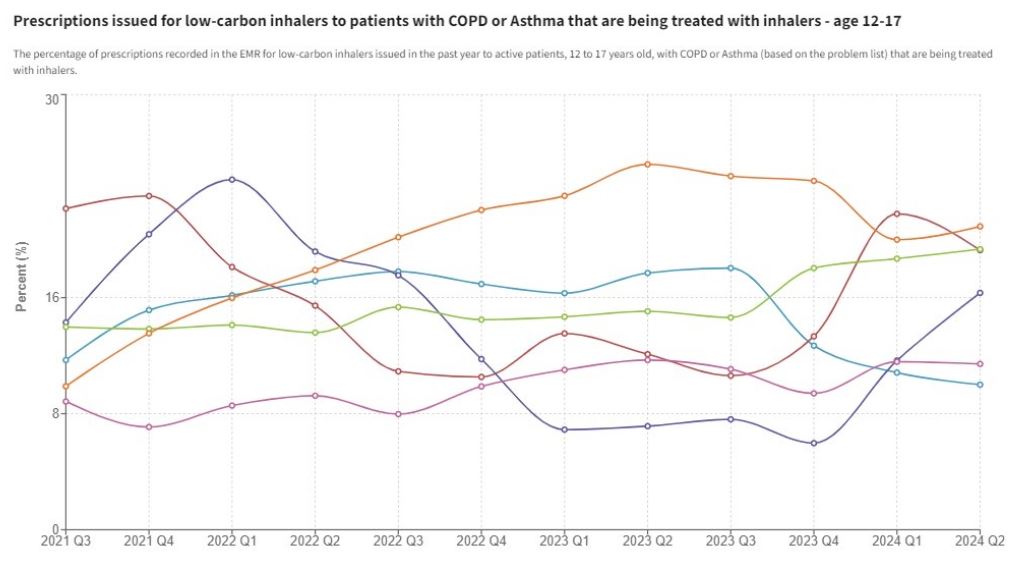
Image: 3 year trend graph example of 6 different regions across the province. Check out what percentage of low-carbon inhalers have been prescribed for your patients living with COPD or Asthma.
Even after we completed this measure development project, new complimentary measures were identified and added to the set, taking a quality improvement approach into our own measurement development process.
“This collaboration on the low-carbon inhaler measure set is a critical step in aligning patient care with planetary health. By reducing high-carbon inhaler use, we improve outcomes for patients living with COPD or asthma while lowering healthcare greenhouse gas emissions. It’s a powerful example of how co-design can drive meaningful change in our health system.”
We are proud of the collaborative relationship we built with Dr. Liang and the speed with which we were able to deliver planetary health measures to support the spread of “low carbon care equates to high quality care” message across the province’s primary care teams. Great things can be accomplished with co-design and collaborative development.
We rely on our user base to tell us when something doesn’t make sense and value the input from our clinician users when they feel something is missing or misaligned. Please reach out to our Support team with your thoughts.