
Dr. Alexander Kilpatrick doesn’t claim to have all the answers. In fact, his guiding mantra—“I don’t know what I don’t know”—is what fuels his relentless pursuit of better care. It’s a humble yet powerful mindset, especially for a new-to-practice physician navigating the complexities of modern medicine.
Raised in Victoria and now a father to three energetic boys, Dr. Kilpatrick juggles the demands of family life with a deeply rooted commitment to his patients. His days are long, filled with clinic hours, surgical assists, maternity care, and emergency shifts. Yet, what keeps him going isn’t just duty—it’s the belief that every small improvement in care can ripple outward, changing lives.
“I want to be the kind of doctor I’d want for my own family,” he says. “that means being present, being proactive, and using every tool I have to make a difference.”
But time is finite. Working longer hours isn’t sustainable—not when his sons are growing up fast and his calendar is already packed with leadership roles in the South Island Division of Family Practice and the Victoria Medical Society. That is where data became his ally.
Proactive Patient Care Through Data Utilization
For Dr. Kilpatrick, good medicine isn’t just about treating illness, it’s about preventing it. He believes that helping patients stay healthy means fewer visits, fewer prescriptions, and fewer complications down the road. But this kind of care takes intention. It takes time. And it takes a willingness to look deeper.
“I’ve learned that small, consistent changes can lead to big outcomes,” he says. “it’s not about overhauling everything overnight—it’s about building habits that last.”
By weaving regular patient reviews and screenings into the rhythm of his clinic, Dr. Kilpatrick is creating a culture of prevention. And at the heart of it all is data—quietly guiding decisions, revealing patterns, and helping him see what might otherwise be missed.
Collaboration That Sparks Change
The turning point came when Kent Marley from the Health Data Coalition (HDC) and Robin Stewart, a Practice Support Program (PSP) coach, approached Dr. Kilpatrick with a simple offer: take a closer look at his data.
He agreed without hesitation.
What followed was more than a review of numbers—it was a moment of clarity. The HDC Discover application allowed Dr. Kilpatrick to compare his clinic’s performance with local and provincial benchmarks. For the first time, he could see where his practice stood—and where it could go.
“It was like turning on a light,” he recalls. “suddenly, I could see the gaps. And once you see them, you can’t ignore them.”
From Insight to Action
One number stood out: only 40% of eligible patients in his panel had received diabetes screening. That wasn’t good enough—not for someone who believes in catching problems before they start.
With Robin’s support, Dr. Kilpatrick built a plan. He focused on patients over 40 with hypertension and elevated BMI—those most at risk. Working closely with his Medical Office Assistant and Registered Nurse, they created custom reports in the EMR to flag patients who needed follow-up.
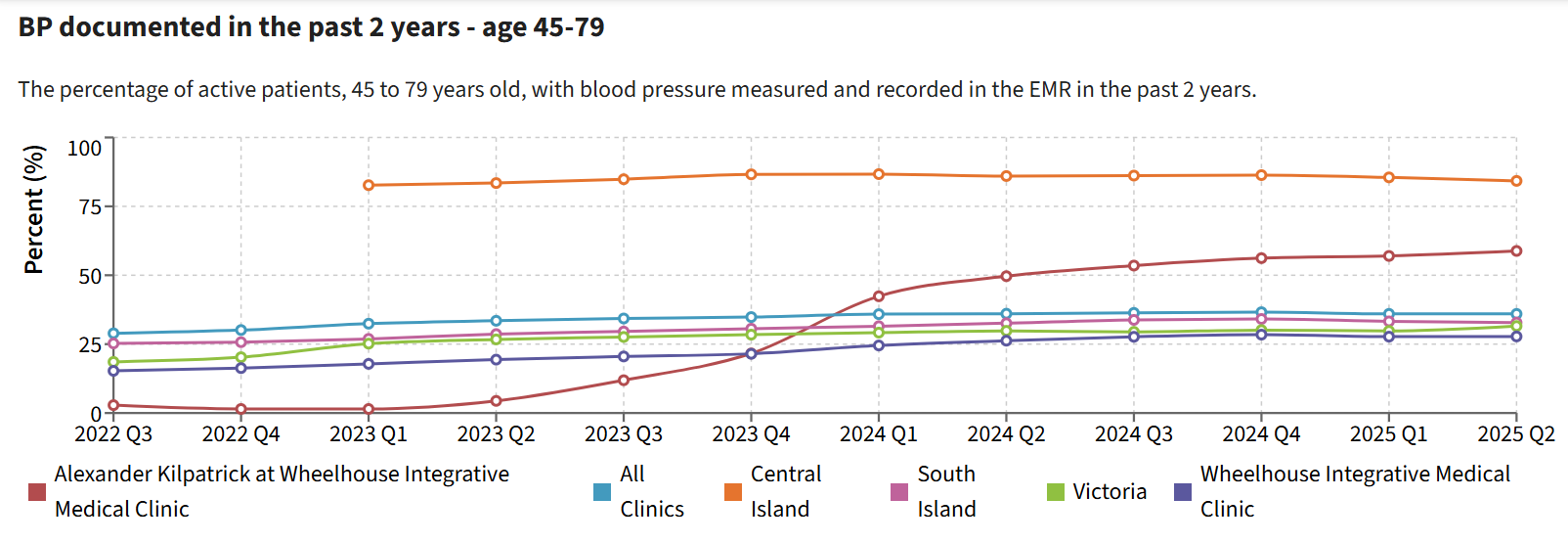
Now, every visit includes a blood pressure check and weight update. It’s a small change, but one that’s reshaping the way he delivers care.

Real Results, Real Impact
Four (4) months later, a follow-up review brought good news: diabetes screening rates had jumped from 40% to up to 72% in some age cohorts. It was a moment of quiet pride, not just for Dr. Kilpatrick, but for the whole team.
“It felt like proof,” he says. “proof that what we’re doing matters. That we’re catching things earlier. That we’re helping people live healthier lives.”
Encouraged by the progress, they expanded their focus—identifying patients with undiagnosed COPD or asthma, overdue screenings, or missing lab results. Each data point became a doorway to better care.
A Practice with Purpose
Dr. Kilpatrick’s journey is far from over. But what’s clear is his unwavering commitment to continuous improvement. He’s not just running a clinic—he’s building a system that works smarter, not harder. One that gives him more time with his patients—and with his sons.
As Dr. Kilpatrick says, “With HDC Discover, it’s allowed me to feel better about the practice that I run and the patient care that I provide, because I can see things that change the way that I’m able to manage my patients. It’s allowed me to be more proactive.”